Real estate agencies handle an enormous volume of sensitive information. From buyer applications and credit reports to lease agreements, tax documents, and bank statements, real estate files are packed with personally identifiable information (PII) and financial data.
Yet many brokerages, especially small to mid-sized firms, still treat document disposal as an afterthought. Old deal folders pile up in storage rooms, expired tenant files sit in filing cabinets, and confidential paperwork is sometimes thrown out with regular trash.
In today’s regulatory environment, improper document disposal isn’t just careless; it’s risky. Failing to shred real estate files properly can lead to fines, lawsuits, regulatory action, and reputational damage that far outweigh the cost of professional shredding services.
This article explains why secure document shredding is essential for real estate agencies, what laws and regulations apply, and how a compliant shredding program protects your business.
Why Real Estate Files Are High-Risk
Real estate transactions touch nearly every aspect of a person’s financial life.
Common real estate documents include:
- Rental and purchase applications
- Credit reports and background checks
- Social Security numbers
- Bank statements and proof of funds
- Tax returns and W-2s
- Driver’s licenses and ID copies
- Lease agreements
- Closing disclosures
- Commission and payroll records
If these documents fall into the wrong hands, the consequences can be severe, for both clients and the agency responsible for safeguarding them.
Legal and Regulatory Requirements Real Estate Agencies Must Follow
Real estate firms are subject to multiple overlapping laws related to data protection and document disposal.
1. FACTA (Fair and Accurate Credit Transactions Act)
FACTA requires businesses that handle consumer credit information to properly dispose of it.
This includes:
- Credit reports
- Background checks
- Financial applications
Improper disposal under FACTA can result in:
- Federal penalties
- Civil lawsuits
- Liability for identity theft
Shredding is one of the primary accepted disposal methods.
2. State Privacy and Data Protection Laws
Most states, including New York, have data protection laws that require “reasonable safeguards” for disposing of private information.
These laws typically cover:
- Social Security numbers
- Financial account information
- Driver’s license numbers
- Personal identifiers
Throwing documents in the trash or recycling bin is not considered a reasonable safeguard.
3. Breach Notification Laws
If improperly discarded documents are accessed by unauthorized parties, agencies may be required to:
- Notify affected individuals
- Notify state authorities
- Pay for credit monitoring
- Face regulatory scrutiny
Even a small paper-based breach can become expensive very quickly.
4. Contractual and Fiduciary Obligations
Real estate agents have fiduciary duties to clients, including:
- Confidentiality
- Care
- Loyalty
Improper document disposal can be seen as a breach of these duties, leading to:
- Client complaints
- Licensing issues
- Civil liability
The Financial Cost of Improper Document Disposal
Failing to shred real estate files properly can result in both direct and indirect costs.
Regulatory Fines and Penalties
Violations of privacy and disposal laws can lead to significant fines, even for small agencies.
Lawsuits and Legal Fees
Clients whose information is exposed may pursue legal action, even if actual harm is minimal.
Reputational Damage
Trust is everything in real estate. A data breach, even a paper one, can:
- Damage your brand
- Cost future listings
- Drive clients to competitors
Operational Disruption
Responding to a breach requires:
- Internal investigations
- Legal counsel
- Staff time
- Regulatory communication
All of which divert focus from revenue-generating activities.
Common Shredding Mistakes Real Estate Agencies Make
Despite the risks, many agencies still rely on outdated practices.
Mistake #1: Office Shredders
Office shredders:
- Encourage inconsistent use
- Jam or break easily
- Provide no proof of destruction
They are not suitable for compliance-driven environments.
Mistake #2: “Shred When We Have Time”
Letting documents pile up:
- Increases exposure risk
- Creates unsecured storage
- Encourages shortcuts
Secure shredding should be routine, not occasional.
Mistake #3: Leaving Disposal to Individual Agents
Without a firm-wide policy, agents may:
- Dispose of documents incorrectly
- Take files home
- Store records in personal vehicles
This creates inconsistent and risky handling.
Mistake #4: No Documentation
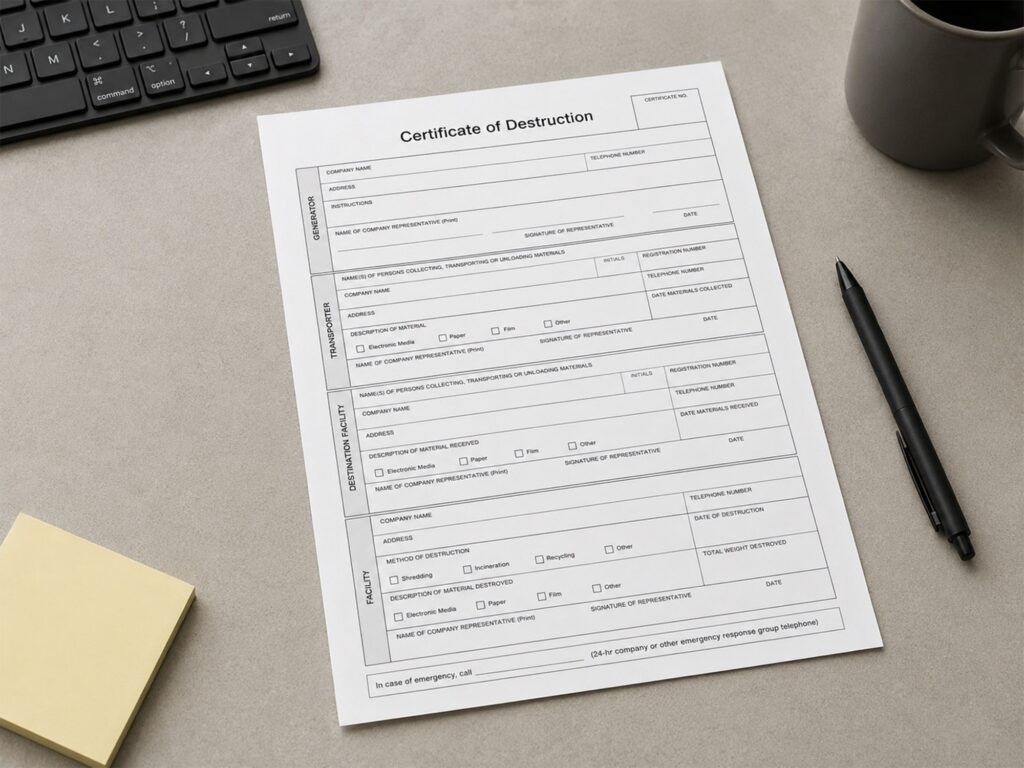
Without certificates of destruction, agencies cannot prove compliance during audits or disputes.
Which Real Estate Documents Must Be Shredded
Any document containing sensitive or personal information should be shredded at end-of-life, including:
- Buyer and renter applications
- Credit and background reports
- Financial disclosures
- Copies of IDs
- Lease applications and expired leases
- Payroll and commission records
- Tax documents
- Old client correspondence
When in doubt, shred it.
When Real Estate Agencies Should Shred Files
Shredding should align with record retention schedules.
Common triggers include:
- End of required retention period
- Expired leases
- Closed transactions beyond statutory limits
- Former employee records
- Duplicate or outdated documents
Shredding too early can violate retention laws, shredding too late increases risk.
How Professional Shredding Services Protect Real Estate Agencies
Professional shredding services are designed to meet regulatory and legal expectations.
1. Locked Collection Consoles
Secure bins placed in offices prevent unauthorized access before destruction.
2. Chain of Custody
Documents are tracked from pickup through destruction, reducing liability.
3. Onsite or Offsite Shredding Options
- Onsite shredding: documents destroyed at your location
- Offsite shredding: cost-effective for high volumes
Both are compliant when performed by certified providers.
4. Certificates of Destruction
Formal documentation provides proof of compliant disposal.
5. Scheduled Service
Regular shredding prevents buildup and ensures consistent compliance.
Why Shredding Is Especially Important for Growing Agencies
As agencies grow:
- Transaction volume increases
- Staff turnover rises
- File complexity grows
- Compliance oversight becomes harder
Professional shredding scales with your business and reduces administrative burden.
Best Practices for Real Estate Shredding Programs
To minimize risk, agencies should:
- Adopt a written document disposal policy
- Use locked shred consoles throughout the office
- Schedule regular shredding services
- Train agents and staff annually
- Align shredding with retention schedules
- Maintain certificates of destruction
- Include digital media in disposal plans
These steps create a defensible compliance framework.
Local Shredding Matters
Local shredding providers understand:
- Regional regulations
- Office building access requirements
- After-hours service needs
This ensures smoother service with less disruption.
Real estate agencies are trusted with some of the most sensitive personal and financial information clients possess. Improper document disposal puts that trust and your business at risk.
Secure, compliant document shredding is not just best practice; it’s a legal and financial safeguard. By implementing a professional shredding program, real estate agencies protect clients, meet regulatory requirements, and avoid costly penalties that can arise from something as simple as a discarded piece of paper.
Emerald Document Imaging helps real estate agencies implement secure, compliant document shredding programs with locked consoles, scheduled service, full chain-of-custody documentation, and certificates of destruction, protecting your business and your clients.