When businesses move physical records to an offsite storage facility, the most common concern is security. What fewer businesses think to ask about is visibility. Knowing that boxes are stored somewhere secure is not the same as knowing exactly where they are, being able to retrieve a specific one on short notice, or being able to prove a complete chain of custody when an auditor, attorney, or regulator asks for documentation.
Barcode tracking for offsite records storage is the system that makes visibility possible. It assigns a unique barcode identifier to each box of records, then scans that barcode at every stage of the document’s lifecycle, from initial pickup through shelving, retrieval, return, and eventual destruction. The result is a real-time inventory system that tells you precisely where every box is, who handled it last, and when it moved.
This article explains how box-level barcode tracking works, why it matters for compliance and retrieval, how it compares to file-level tracking, and what questions to ask a storage provider to verify their system is actually doing what they say it does.
Why “We Have Your Boxes” Is Not Enough
Most businesses that use offsite storage have little visibility into what happens after a truck picks up their records. Boxes go to a facility. Someone signs something. The records are presumably shelved somewhere. When a box is needed, a request goes in and the box comes back, eventually.
That process works until it does not. An audit requires records from three years ago and nobody is certain which facility has them. A legal hold requires producing documents related to a specific matter and the request sits for days while staff at the storage facility search manually. A box that was requested is returned with the wrong contents. A box that was supposedly retrieved and returned turns out to still be sitting on a shelf.
These are not unusual scenarios. According to research from Gartner, 7.5 percent of all physical documents are lost entirely, and 3 percent of the remainder are misfiled or incorrectly stored. In a large archive without systematic tracking, those numbers compound quickly.
The fundamental problem is that informal storage systems treat records as cargo rather than inventory. Barcode tracking closes that gap by bringing the same inventory control logic used in supply chain management to the management of physical records.
How Box-Level Barcode Tracking Works
Box-level tracking means that the unit of accountability is the individual box, not the pallet, the row, or the room. Every box gets its own unique identifier, and every movement of that box generates a scannable record. Here is how the process works from start to finish.
Labeling and Initial Scan-In
Before any box leaves your facility, it is assigned a unique barcode label. In some systems, your organization applies labels in advance and enters basic metadata, such as department, record type, date range, and contents description. In others, the storage provider labels boxes at pickup and links them to your account in their inventory system.
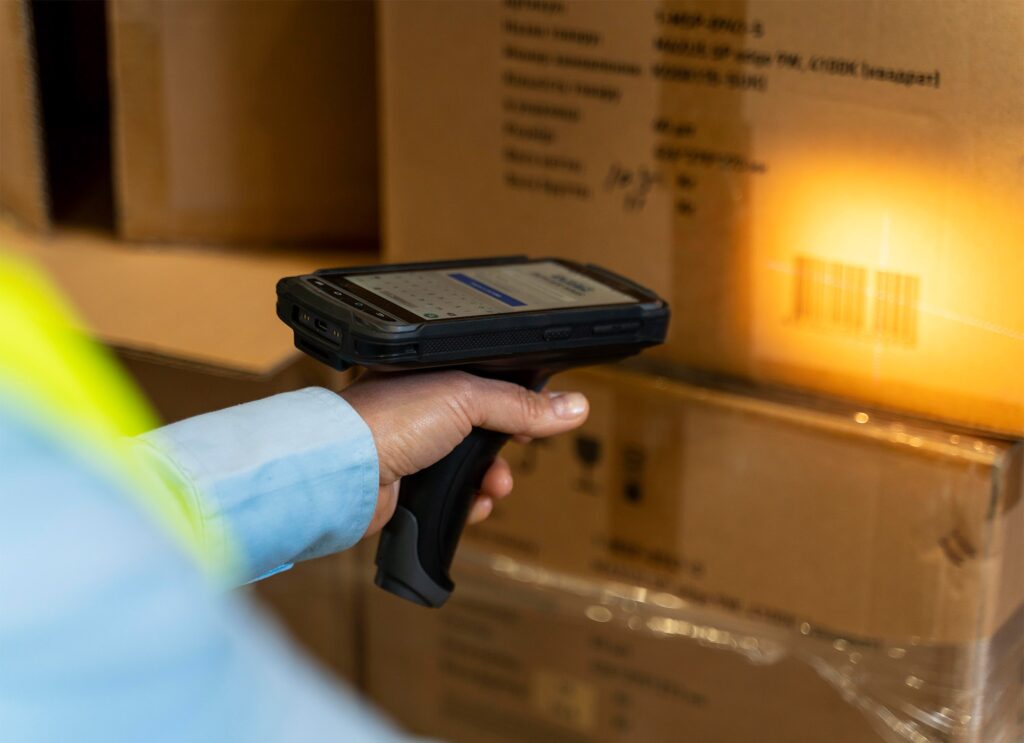
At pickup, each box barcode is scanned and recorded along with the date, time, pickup location, and the identity of the person who handled it. This scan establishes the first entry in the chain of custody and connects the physical box to its digital record in the storage provider’s tracking system.
Transport and Receiving at the Facility
When boxes arrive at the storage facility, they are scanned again at receiving. This confirms that every box that was picked up has arrived, creates a second chain of custody entry, and triggers the shelving process. Any discrepancy between what was picked up and what was received is flagged immediately rather than discovered weeks later when someone tries to retrieve a missing box.
Shelving and Location Assignment
Once received, each box is assigned to a specific location in the facility, typically identified by aisle, bay, and shelf number. That location is recorded in the tracking system and linked to the box barcode. This is the step that makes retrieval reliable. Rather than a staff member searching a general area for a box that might be “somewhere in row seven,” the system shows exactly where it is.
Retrieval Requests and Delivery
When you request a box, you submit the request through the storage provider’s client portal, by phone, or by email, referencing the barcode number or the descriptive metadata associated with the box. The facility staff pull the box by scanning its location barcode, confirm the match, scan it out of inventory, and record the retrieval event.
Whether the box is delivered physically or its contents scanned on demand, the tracking system records who requested it, when, and from where. For businesses subject to compliance audits, this retrieval log is as important as the records themselves.
Return and Reinstatement
When a retrieved box is returned to the facility, it is scanned back in and reinstated to its assigned location, or to a new one if the original shelf has been reallocated. The return event is logged with the same timestamp and identity tracking as every other movement. The box’s history in the system now reflects the complete record of where it has been and who has touched it.
Permanent Removal and Destruction
When records reach the end of their retention period and are authorized for destruction, the facility scans each box out of inventory permanently, documents the destruction event, and typically provides a certificate of destruction that includes the barcode identifiers of every box destroyed. That certificate closes the chain of custody and provides the compliance documentation your organization needs to show that records were disposed of properly.
Box-Level vs. File-Level Tracking
Box-level tracking manages inventory at the container level. Each box has a barcode, and the system knows where the box is. What it does not necessarily know is exactly which files or folders are inside each box.
File-level tracking goes one step deeper. Each folder, hanging file, or individual document inside a box is given its own barcode identifier, creating an inventory that can track the movement of a single file out of a box and back again. This level of detail is valuable for organizations that frequently retrieve individual documents rather than whole boxes, such as law firms managing active case files or healthcare organizations handling ongoing patient record requests.
For most businesses, box-level tracking provides the right balance of control and cost. File-level tracking adds meaningful overhead in labeling, data entry, and system management, and it is most justified when the volume and frequency of individual file retrievals make the investment worthwhile.
When evaluating a storage provider, it is worth asking which level of tracking they offer, whether file-level tracking is available as an add-on, and how they handle partial box retrievals when only certain documents need to come out.
What Barcode Tracking Means for Compliance
For organizations in regulated industries, barcode-based inventory control is not a convenience. It is a compliance requirement in practice, even when not explicitly mandated by law.
Regulations like HIPAA, SEC Rule 17a-4, FINRA recordkeeping rules, and various state-level retention statutes require that organizations be able to produce records on demand, demonstrate that records were retained for the required period, and show that records were disposed of properly at the end of their retention schedule. Meeting those requirements is extremely difficult without a systematic tracking mechanism.
A barcode-based system provides three things that compliance teams need:
- A complete chain of custody record showing every person who handled a box and every location it occupied
- A retrieval log documenting when records were accessed and by whom, which supports access control requirements in regulated environments
- A destruction record with box-level detail, suitable for producing as evidence of compliant disposal
Beyond regulatory compliance, barcode tracking also supports legal holds. When litigation or a regulatory investigation requires that certain records be preserved, the tracking system allows your storage provider to flag specific boxes as subject to a hold, preventing them from being destroyed or released without explicit authorization.
Evaluating a Storage Provider’s Tracking System
Not all offsite storage facilities offer the same level of barcode tracking, and the marketing language around “inventory control” and “chain of custody” can obscure meaningful differences in capability. When speaking with a storage provider, these are the questions that reveal how their system actually works:
- What triggers a scan event? Every movement, including pickup, receiving, shelving, retrieval, and destruction, should generate a scan record. If the answer is vague, the system likely has gaps.
- Can you access your inventory in real time? Most modern storage providers offer a client portal where you can view your inventory, submit retrieval requests, and see activity logs. If real-time access is not available, you are dependent on the facility’s staff for information that should be self-service.
- How are retrieval requests tracked? You should be able to see who requested a box, when the request was made, when the box was pulled, and when it was returned, all in one log.
- What documentation is provided at destruction? A certificate of destruction should include the date, the method of destruction, and the barcode identifiers of every box destroyed.
- What happens if a box cannot be located? This question tells you a great deal. A facility with genuine inventory control will have a defined process for investigating a missing box, including reviewing scan records to identify where it was last seen. A facility without real tracking will not have much to offer beyond a manual search.
- What is the accuracy rate of your inventory? Some providers can share data on inventory accuracy. A well-run barcode system should be able to account for virtually every box in the facility at any given time.
Offsite records storage is a sound solution for businesses managing large volumes of physical documents. But the value of that storage depends entirely on whether you can find, retrieve, and account for your records when you need them. Secure shelving in a climate-controlled facility is the baseline. Barcode-based inventory control is what transforms storage into a managed, auditable system.
Box-level tracking gives businesses real-time visibility into where their records are, a complete chain of custody for every box, reliable retrieval on short notice, and the compliance documentation that auditors, attorneys, and regulators may require. Without it, offsite storage is simply a more organized version of the problem you were trying to solve.
Frequently Asked Questions
What is box-level barcode tracking in offsite records storage?
Box-level barcode tracking is an inventory control system that assigns a unique barcode to each box of records stored at an offsite facility. Every time a box moves, whether it is being received, shelved, retrieved, or destroyed, the barcode is scanned and the event is recorded in the tracking system. This creates a complete, time-stamped chain of custody for every box in storage.
How is barcode tracking different from standard offsite storage?
Standard offsite storage may involve basic intake records and manual shelving without systematic scanning at each stage. Barcode tracking adds scan events at every point of movement, creating an auditable log rather than a static intake record. The practical difference is that with barcode tracking you can see exactly where a box is at any moment and who handled it last. Without it, locating a specific box depends on staff memory and manual searching.
Can I see my inventory in real time if my records are stored offsite?
With a barcode-tracking system and a client portal, yes. Most modern offsite storage providers that use barcode tracking offer a web-based portal where clients can view their current inventory, search for specific boxes by barcode or metadata, submit retrieval requests, and review activity logs. If a storage provider cannot offer this, their inventory control system is likely less sophisticated than it should be.
Does barcode tracking create a record I can use for compliance purposes?
Yes. Barcode tracking systems generate logs of every scan event, including who handled a box and when. For organizations subject to HIPAA, FINRA, SEC, or other records retention regulations, these logs support chain of custody documentation, access control records, and certificates of destruction, all of which may be required during an audit or legal proceeding.
What is the difference between box-level and file-level tracking?
Box-level tracking manages inventory at the container level, meaning the system knows where each box is but not necessarily what individual files are inside it. File-level tracking assigns a unique barcode to each individual folder or document within a box, creating a more granular inventory that can track the movement of a single file. File-level tracking is better suited for organizations with frequent individual document retrievals, such as law firms or healthcare providers. Box-level tracking is sufficient for most businesses that retrieve whole boxes rather than individual files.
What should a certificate of destruction include for compliance purposes?
A certificate of destruction for physical records should include the date of destruction, the method used (such as shredding or incineration), the name of the destruction vendor if applicable, and the unique barcode identifiers of every box that was destroyed. This level of detail provides the specific documentation needed to demonstrate to auditors or regulators that records were disposed of in accordance with retention schedules and applicable laws.
If your business stores physical records offsite or is evaluating offsite storage options, Emerald Document Imaging offers secure records storage with barcode-based inventory control, real-time client access, and complete chain of custody documentation. Learn more about our Offsite Document Storage services and request a quote.