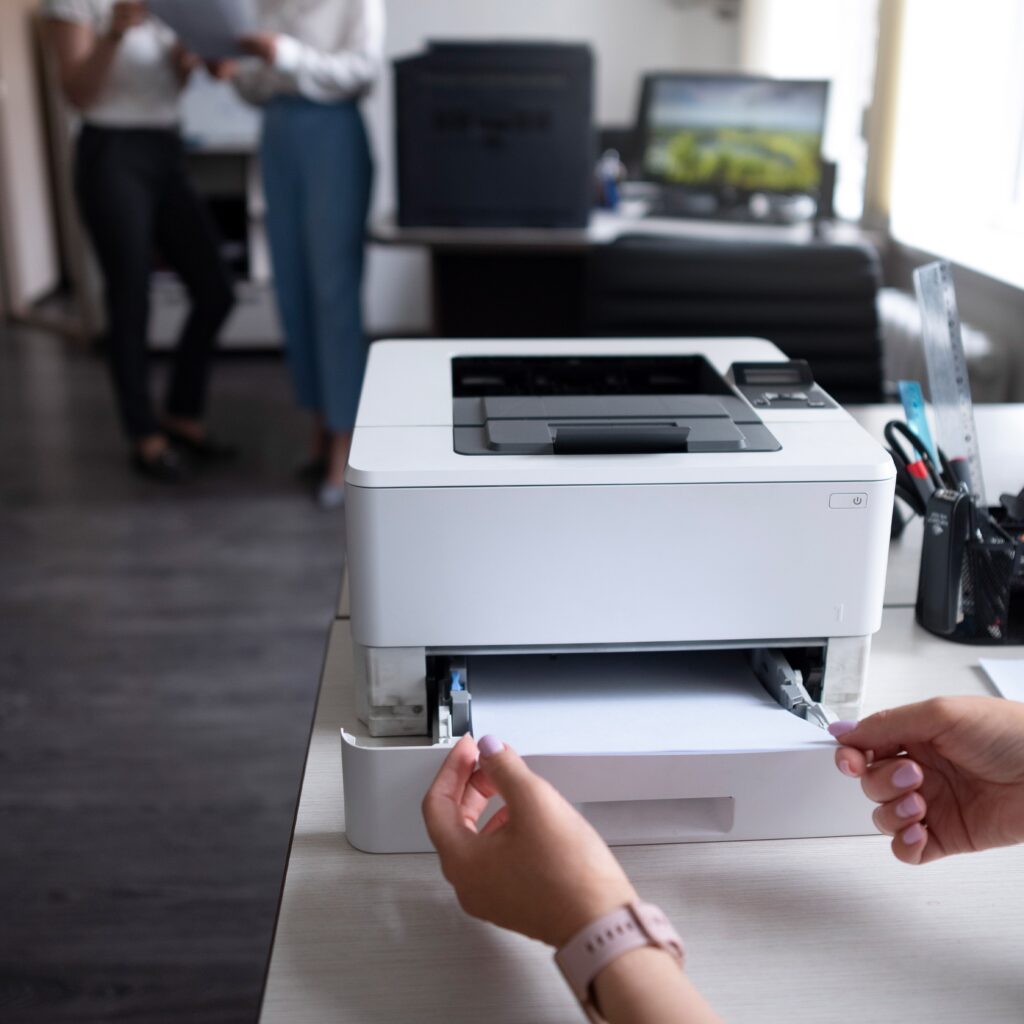
Most businesses underestimate (or wildly overestimate) how much they actually print each month. That miscalculation leads to overspending on oversized copiers or overworking undersized machines.
This guide explains how to calculate your true monthly print volume, why it matters, and how to use that number to choose the right equipment and control long-term costs.
If you don’t know your page volume, you’re guessing when it comes to leasing, buying, or optimizing your office print environment.
Why Monthly Print Volume Matters
Your monthly print volume directly affects:
- Copier size and speed requirements
- Lease pricing and service agreements
- Toner usage
- Maintenance frequency
- Device lifespan
- Cost per page
Choosing equipment without knowing your volume often results in:
- Overpaying for capacity you don’t need
- Frequent breakdowns from overuse
- Higher service costs
- Premature upgrades
Volume is the foundation of smart print planning.
Step 1: Check Your Current Copier’s Meter Reading
The easiest way to determine your monthly volume is to pull your device meter readings.
Most multifunction printers (MFPs) track:
- Total lifetime page count
- Black-and-white vs. color prints
- Scan volumes
To estimate your monthly volume:
- Record the total page count.
- Check again 30 days later.
- Subtract the difference.
That number is your true monthly usage.
If you lease your copier, your service provider may already track this data.
Step 2: Estimate Volume If You Don’t Have Data
If you’re starting fresh or replacing old equipment, estimate using employee-based benchmarks.
Typical Print Volume by Office Type
- Light-use office: 300–500 pages per employee per month
- Moderate-use office: 500–1,000 pages per employee per month
- High-volume office: 1,000+ pages per employee per month
Example Calculations
10-person office (moderate use):
10 × 700 pages = 7,000 pages/month
25-person office (moderate to high use):
25 × 900 pages = 22,500 pages/month
50-person office (high use):
50 × 1,200 pages = 60,000 pages/month
These are starting points, not exact numbers.
Industry matters.
Print Volume by Industry
Some industries print far more than others.
Law Firms
- Contracts
- Case files
- Court documents
- Discovery materials
Often high-volume environments.
Healthcare Offices
- Patient records
- Forms
- Compliance documentation
Moderate to high volume, depending on digitization.
Financial Institutions
- Reports
- Client documentation
- Regulatory paperwork
Moderate volume with strong security needs.
Marketing & Creative Teams
- Draft proofs
- Promotional materials
- Client presentations
High color usage.
Understanding your industry’s norms helps refine projections.
Step 3: Separate Black & White vs. Color
Color printing is significantly more expensive than black and white.
You should determine:
- Total pages
- Percentage of color
- Percentage of simplex vs. duplex
A 20,000-page office with 5% color behaves very differently than one with 40% color.
Color-heavy environments may require:
- Larger toner capacity
- Different cost-per-page structures
- Higher-end devices
Ignoring color ratio distorts your budgeting.
Step 4: Account for Seasonal Spikes
Many businesses experience predictable surges.
Examples:
- Accounting firms during tax season
- Universities during enrollment periods
- Construction firms during major project submissions
- Marketing agencies before campaign launches
If your average is 15,000 pages per month but you spike to 30,000 during peak months, your copier must handle the higher number—not the average.
Under-sizing for peak volume shortens equipment lifespan.
Step 5: Understand Duty Cycle vs. Recommended Volume
Manufacturers list two numbers:
- Maximum duty cycle (absolute limit)
- Recommended monthly volume (safe operating range)
Always size equipment based on recommended volume, not maximum duty cycle.
Running near maximum consistently:
- Increases wear
- Raises service calls
- Reduces lifespan
A copier rated for 80,000 maximum pages may only recommend 25,000–30,000 monthly for optimal performance.
How Volume Impacts Copier Selection
Here’s a simplified framework:
| Monthly Volume | Suggested Device Tier | Typical PPM |
| 2k–10k | Small workgroup MFP | 25–35 PPM |
| 10k–30k | Mid-size departmental | 35–55 PPM |
| 30k–75k+ | High-capacity / light production | 50–70+ PPM |
Speed (PPM) matters less than volume capacity.
Many businesses focus only on speed. That’s a mistake.
Durability matters more.
The Cost of Getting It Wrong
If You Overestimate Volume
- Higher lease payments
- Larger footprint
- More expensive service agreements
- Unused capacity
If You Underestimate Volume
- Increased breakdowns
- Frequent toner replacement
- Higher per-page costs
- Early replacement
Right-sizing protects both your budget and your workflow.
Print Volume and Managed Print Services (MPS)
If you manage multiple devices across departments, tracking volume manually becomes difficult.
Managed Print Services help:
- Monitor usage automatically
- Track department costs
- Enforce print rules
- Reduce waste
- Optimize device placement
Businesses often discover they print far more, or far less, than they assumed.
In many metro offices, data-driven print tracking reveals 10–20% waste that can be eliminated.
Should You Be Printing Less?
Many organizations are transitioning to digital workflows.
Reducing print volume can:
- Lower operating costs
- Reduce paper waste
- Improve document security
- Free up office space
However, eliminating printing entirely is unrealistic for most industries.
The goal isn’t zero printing.
The goal is controlled printing.
A Simple 5-Question Print Volume Audit
Before upgrading equipment, ask:
- What is our verified monthly page count?
- What percentage is color?
- What are our peak months?
- Are we growing or downsizing?
- Could workflow automation reduce volume?
Answering these questions positions you to make smarter financial decisions.
Knowing how many pages your office prints each month is not a trivial statistic. It determines:
- Equipment selection
- Lease structure
- Service costs
- Supply planning
- Long-term ROI
Most businesses guess. The smartest businesses measure.
Understanding your real print volume ensures you choose the right device, not just the fastest or cheapest option available.