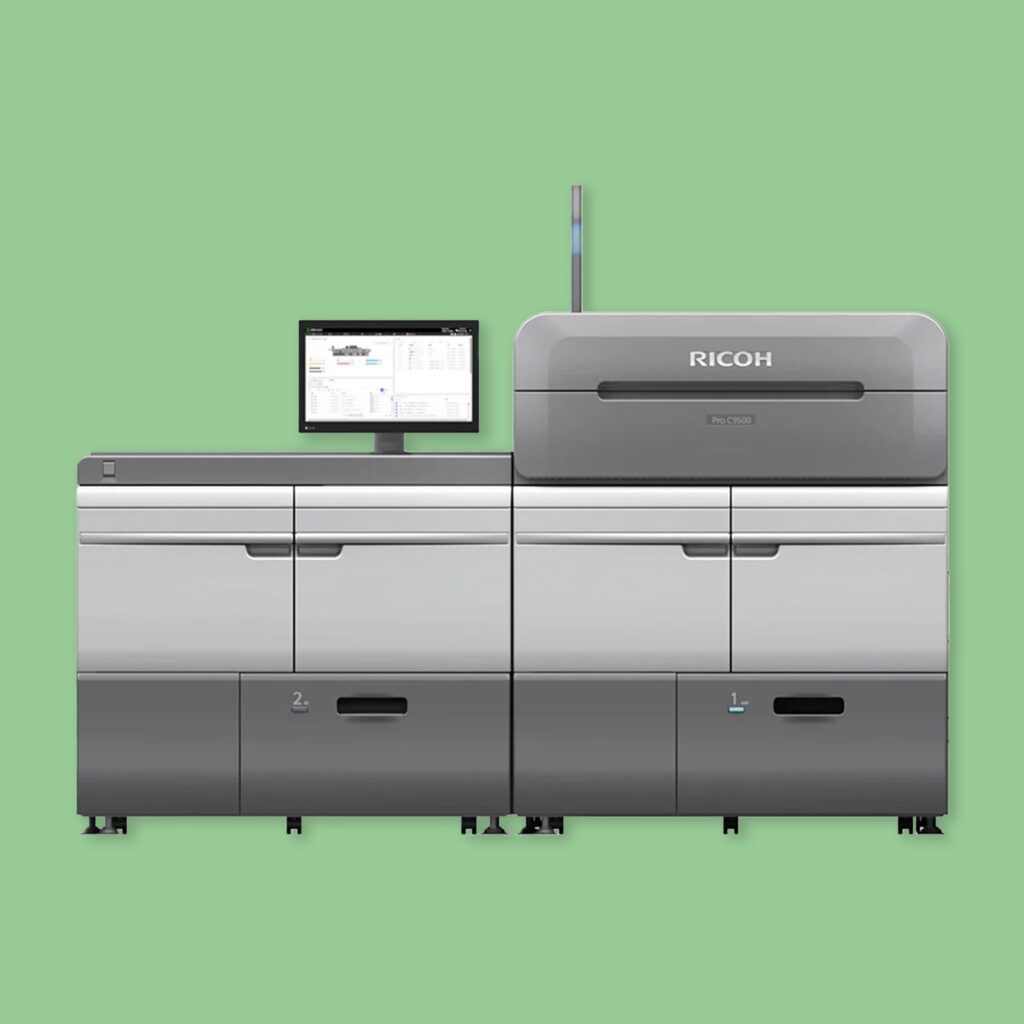
Investing in a production printing press is a major financial decision. These systems often represent six-figure investments, and leadership teams want clear justification before approving the purchase.
This guide explains how to calculate ROI on a production printing press by evaluating outsourcing costs, labor savings, efficiency gains, revenue opportunities, and total cost of ownership.
ROI is not just about how much the machine costs. It’s about what it replaces and what it enables.
Step 1: Identify Your Current Print Spend
Before calculating ROI, you need a baseline.
Start by documenting:
- Annual outsourcing costs
- Cost per outsourced job
- Rush fees
- Shipping expenses
- Labor spent managing vendors
For example:
- Annual outsourced print spend: $120,000
- Rush and shipping fees: $15,000
- Internal labor managing vendors: $10,000
Total annual external print-related spend: $145,000
This is your starting point.
Step 2: Estimate the Total Cost of Ownership (TCO)
Now calculate the cost of owning and operating a production printer.
Include:
- Equipment financing or lease cost
- Service contract
- Toner and consumables
- Paper
- Energy
- Operator labor
Example:
- Equipment lease: $4,000/month = $48,000/year
- Service contract: $12,000/year
- Supplies and paper: $20,000/year
- Additional labor allocation: $15,000/year
Total annual ownership cost: $95,000
Step 3: Compare Annual Cost Difference
Now compare:
Outsourcing total: $145,000
In-house production total: $95,000
Difference:
(That’s $145,000 – $95,000 = $50,000 in annual savings.)
Annual direct savings: $50,000
This does not yet include revenue growth or workflow acceleration benefits.
Step 4: Calculate Payback Period
If your production press requires:
- $150,000 total investment (or total lease commitment value)
Divide investment by annual savings:
(That’s $150,000 / $50,000 = 3 years.)
Payback period: 3 years
After that point, savings improve net financial performance.
Step 5: Account for Revenue Opportunities
Many businesses underestimate the revenue potential of bringing production printing in-house.
Consider:
- Faster campaign turnaround
- Expanded service offerings
- Variable data printing capabilities
- On-demand printing for clients
If your internal marketing team can produce:
- $30,000 in additional revenue annually
- Or increase campaign output without additional agency fees
That revenue shortens ROI timelines significantly.
ROI should factor in both cost savings and revenue generation.
Step 6: Evaluate Labor Efficiency Gains
Inline finishing features can eliminate manual tasks such as:
- Hand stapling
- Booklet assembly
- Sorting and trimming
If staff currently spend:
- 10 hours per week finishing jobs
- At $30/hour
That equals:
10 × 52 × 30 = $15,600 annually
Automation reduces this cost substantially.
Labor efficiency often accelerates ROI faster than outsourcing savings alone.
Step 7: Consider Downtime and Opportunity Cost
Outsourcing introduces delays:
- Waiting on vendor turnaround
- Revisions and reprints
- Shipping lag
In-house production reduces lead times from days to hours.
Faster execution may allow:
- More campaigns annually
- Faster sales cycles
- Improved customer responsiveness
While harder to quantify, opportunity cost improvements influence strategic ROI.
Step 8: Measure Cost Per Page Reduction
Production printers often reduce cost per page compared to:
- Office copiers
- Commercial vendor pricing
If your outsourced color job costs $0.25 per page and in-house production costs $0.12 per page:
Savings per page = $0.13
At 500,000 pages annually:
(That’s 500,000 × 0.13 = $65,000 annual savings.)
Cost-per-page analysis often reveals larger savings than expected.
Step 9: Factor in Growth Projections
ROI should account for:
- Volume increases
- Marketing expansion
- Additional departments using print
- Multi-location consolidation
If print volume grows 15% annually, savings compound.
Underestimating growth leads to conservative ROI calculations.
Step 10: Calculate Multi-Year ROI
ROI formula:
ROI = (Total Benefit – Total Cost) ÷ Total Cost
Example over five years:
Total savings over 5 years: $50,000 × 5 = $250,000
Total cost over 5 years: $150,000
(That’s (250,000 – 150,000) / 150,000 = 0.66 or 66% ROI.)
That’s before factoring additional revenue.
Common ROI Mistakes
Avoid these errors:
- Ignoring labor savings
- Underestimating outsourcing expenses
- Forgetting service and consumable costs
- Modeling only one year instead of five
- Ignoring downtime impact
Comprehensive modeling gives leadership confidence.
When ROI Justifies Upgrading
Upgrading to a production press makes strong financial sense when:
- Outsourcing exceeds $75,000–$100,000 annually
- Volume consistently surpasses 40,000–50,000 pages per month
- Labor finishing costs are significant
- Campaign speed impacts revenue
- Growth projections are stable
ROI is strongest when cost reduction and revenue expansion align.
Strategic Considerations Beyond ROI
Financial return is critical—but strategic value matters too.
Production printing supports:
- Brand control
- Data security
- Faster compliance documentation
- Reduced vendor dependency
For many organizations, strategic independence adds long-term value beyond pure math.
Calculating ROI on a production printing press requires more than comparing equipment cost to outsourcing invoices. You must evaluate total cost of ownership, labor efficiency, revenue potential, cost per page, and long-term growth.
When modeled properly, many businesses discover that production equipment pays for itself within two to four years, sometimes sooner.
The key is building a five-year financial projection that reflects your real workflow.