A common complaint about office scanning has nothing to do with the scanner itself: it’s what happens after you hit scan. If the file lands in a folder nobody checks, or someone has to manually upload it to Google Drive or SharePoint later, the scanner isn’t actually saving anyone time. It’s just moving the manual work one step downstream.
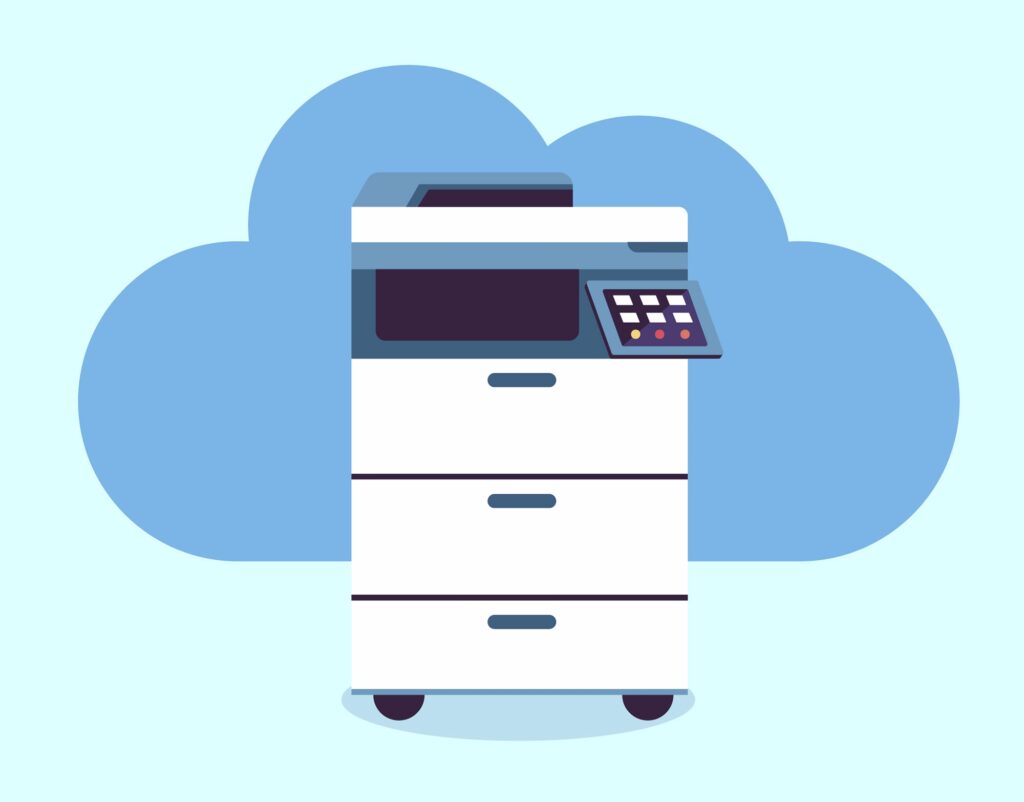
Most modern multifunction printers can skip that extra step entirely and scan straight into Google Drive, Microsoft SharePoint, or OneDrive. Once it’s set up correctly, a scanned document can land in the exact folder it belongs in within seconds, with no computer or manual upload required in between.
Here’s how that connection works, what it takes to set up, and where it tends to trip people up.
What Direct Cloud Scanning Actually Does
Instead of scanning to a USB drive, an email attachment, or a folder on a local computer, the MFP uploads the scanned file directly to a cloud storage location you’ve set up in advance, often into a specific folder tied to a department, client, or project. The file shows up in Google Drive or SharePoint within moments, already in the right place, without anyone needing to touch a computer in between.
How the Connection Works
Authentication
The MFP needs permission to access your cloud storage account, which usually means signing in through the device’s touchscreen or a web-based admin panel the first time it’s set up. Most manufacturers support this through their own cloud connector software rather than a generic login screen, and the login is typically a one-time setup rather than something staff repeat with every scan.
Folder Structure
Before connecting anything, it helps to decide how scans should be organized. Some offices set up a single top-level folder with subfolders by department or client. Others let each employee scan to their own personal drive folder. Getting this structure right before you connect the MFP saves a cleanup project later, since retroactively reorganizing hundreds of scanned files is far more tedious than planning the structure up front.
Permissions and Shared Drives
If your organization uses shared or team drives rather than individual accounts, make sure the MFP’s connection is authorized against the shared drive, not a single employee’s personal account. Otherwise, scans can end up tied to one person’s login and become inaccessible if that person leaves or changes roles, which is a surprisingly common problem in offices that set this up quickly without thinking through account ownership.
Setting It Up: What to Expect
Manufacturer cloud platforms, like Ricoh’s cloud connector tools, handle the back-and-forth between the device and your cloud storage provider. Setup typically involves registering the MFP with the manufacturer’s cloud service, linking that service to your Google Workspace or Microsoft 365 account, and then configuring which folders show up as scan destinations on the device’s touchscreen.
Most of this can be handled by your equipment provider during installation or as a follow-up visit, which is usually faster and less error-prone than trying to configure account permissions and folder mapping from scratch without prior experience.
Common Issues to Watch For
- Scans landing in the wrong account because the connection was authorized under an individual’s login instead of a shared drive
- File size limits causing large, high-resolution scans to fail silently
- Expired authentication tokens that need to be refreshed periodically, especially after a password change
- Employees not knowing which folder button on the touchscreen corresponds to which destination
Is This Worth Setting Up for a Small Office?
Even a small office benefits once staff are regularly scanning more than a few documents a week. The setup takes some initial effort, but it removes a manual step that adds up over time and reduces the odds of a scanned file sitting on a shared computer where it’s easy to lose track of. For offices already using Google Workspace or Microsoft 365 as their primary system, it’s a natural extension of tools staff already know how to use.
What This Looks Like Day to Day Once It’s Set Up
In practice, an employee walks up to the MFP, selects the appropriate destination button, scans the document, and it appears in the correct shared drive folder within moments. No email to send, no USB drive to manage, and no reminder to upload it later before it gets forgotten on a desk. For offices that scan contracts, invoices, or client paperwork daily, this small change in workflow tends to save more time in aggregate than any single feature upgrade to the printer itself.
Choosing Between a Manufacturer App and a Third-Party Connector
Beyond the built-in cloud tools that come with your MFP, there are also third-party print and scan management platforms that offer similar cloud routing along with additional features like usage tracking, cost allocation by department, and more granular permission controls. For a small office, the manufacturer’s own connector is usually simpler to set up and sufficient. For a larger organization already using a print management platform for other reasons, it may make sense to route cloud scanning through that same system rather than adding a separate manufacturer tool.
There’s no universally right answer here. The manufacturer route tends to be faster to set up and requires fewer moving parts, while a third-party platform offers more centralized control if you’re already managing several other print-related settings through it. If you’re unsure which fits, it’s worth asking your equipment provider to walk through both options with your specific cloud storage setup in mind.
Frequently Asked Questions
Does every MFP support direct scanning to Google Drive or SharePoint?
Most current business-class MFPs from major manufacturers support this, usually through the manufacturer’s own cloud connector software rather than a generic built-in feature. Older devices may need a firmware update or may not support it at all.
Is scanning directly to the cloud secure?
Reputable manufacturer cloud connectors use encrypted connections and require authentication, similar to logging into your cloud storage from a browser. The bigger risk is usually misconfiguration, like connecting to the wrong account, rather than the connection itself.
What happens if our internet goes down?
Cloud scanning requires an active internet connection, so scans typically fail or queue until connectivity returns, depending on the device. Most MFPs can still scan to email or a local folder as a backup during an outage.
Can we set up different scan destinations for different departments?
Yes, most setups allow multiple folder destinations to appear as buttons on the device touchscreen, so accounting, HR, and other departments can each have their own scan target.
Do we need IT support to set this up, or can we do it ourselves?
Basic setup is often manageable without dedicated IT staff, especially with guidance from your equipment provider, but getting the account permissions and folder structure right beforehand makes the process much smoother.
Can we scan to more than one cloud platform from the same MFP?
In most cases, yes. Many devices can be configured with destination buttons for Google Drive, SharePoint, and OneDrive at the same time, which is useful for offices that use different platforms for different departments or clients.
Get Your MFP Talking to Your Cloud Storage
If your office is still scanning to email attachments or a shared folder nobody checks, connecting your MFP directly to Google Drive, SharePoint, or OneDrive is a straightforward upgrade.
Explore our multifunction printers and copiers or contact us and we can walk through the setup for your office.