A dry-erase board and a projector cost a fraction of an interactive whiteboard, which raises a fair question for any business or school evaluating the upgrade: what does the added cost actually buy, and does it matter enough for your specific use case to justify it?
Here’s an honest comparison of what each setup offers, rather than a sales pitch for the more expensive option.
What a Traditional Whiteboard and Projector Setup Offers
A dry-erase board is simple, familiar, and requires no technology to operate. Paired with a projector, it can display slides or a computer screen alongside handwritten notes. The combination works fine for straightforward presentations and meetings where the main need is displaying content and occasionally writing on a board, without much need for interactivity or saving what was written.
What an Interactive Whiteboard Adds
Saving and Sharing What’s Written
Notes, diagrams, and annotations made during a meeting can be saved digitally and shared afterward, rather than disappearing the moment someone erases the board or takes a photo with their phone. This alone solves a common, low-grade frustration in meetings where good ideas captured on a whiteboard get lost once the room is needed for something else.
Direct Interaction With Digital Content
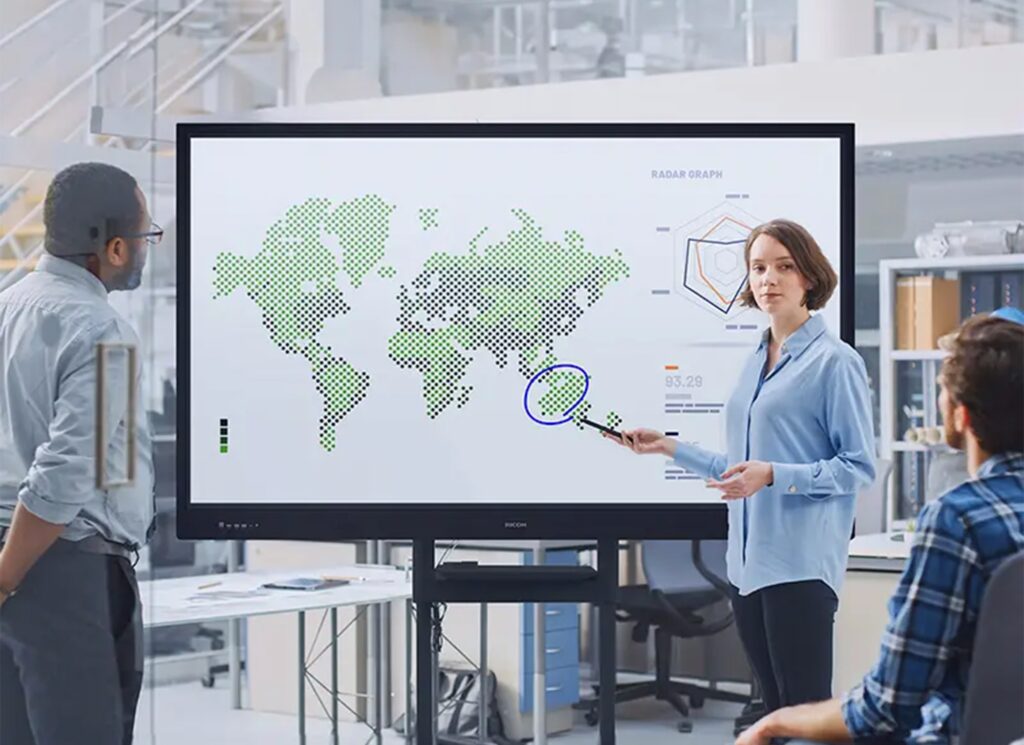
An interactive whiteboard lets users annotate directly on a shared document, spreadsheet, or presentation rather than just displaying it and writing separately on a physical board. This blurs the line between the digital content being presented and the collaborative notes being added to it, which a projector and separate whiteboard can’t replicate.
Built-In Video Conferencing Integration
Many interactive whiteboards integrate directly with video conferencing platforms, letting remote participants see and sometimes interact with what’s being written in real time. A traditional whiteboard requires a separate camera pointed at the board, which rarely captures handwriting clearly for remote viewers.
Where Interactive Whiteboards Deliver the Most Value
The upgrade tends to matter most for businesses and schools with frequent collaborative meetings, hybrid teams that regularly include remote participants, or training environments where saving and revisiting content adds real value.
Our guide on the best interactive whiteboard features for meetings and team collaboration covers specific features worth prioritizing once you’ve decided the upgrade makes sense for your situation.
Where a Traditional Setup Is Still Fine
A conference room used mostly for straightforward presentations, with infrequent need to save or share handwritten notes and little to no remote participation, may not see enough benefit to justify the added cost. It’s worth being honest about how a specific room or team actually uses meeting space rather than assuming every room needs the same upgrade.
Common Use Cases That Tip the Decision
Businesses that run frequent client presentations, training sessions, or brainstorming meetings tend to see the interactive whiteboard’s advantages show up quickly in practice.
Our guide on using interactive whiteboards for dynamic business presentations covers specific scenarios where the format changes how a presentation actually lands with an audience.
A Practical Way to Decide
Rather than deciding room by room based on budget alone, it helps to look at how each space is actually used: how often meetings involve remote participants, how often notes or diagrams need to be saved and referenced later, and how much value collaborative annotation would add to the kind of work that happens there.
Rooms that score high on those questions are strong candidates for an interactive whiteboard, while simpler presentation-only spaces may be fine with a traditional setup.
A Phased Approach to Upgrading
Few businesses need to upgrade every room at once, and a phased approach is often more practical than a wholesale replacement. Starting with the one or two rooms used most heavily for collaborative or hybrid meetings lets a business see the real, practical benefit firsthand before deciding whether to extend the upgrade to additional spaces. This also gives staff time to get comfortable with the new format in a lower-stakes way before it becomes the default across the whole office.
Leasing options can make this phased approach even more manageable financially, spreading the cost across a predictable monthly payment rather than requiring a large upfront investment across every room at once.
Making the Final Call
In the end, this decision comes down to matching the technology to how a specific room is actually used, not to a general belief that newer is always better. A business that thoughtfully upgrades its most collaborative spaces while leaving simpler presentation rooms as they are will usually get more genuine value than one that either upgrades everything reflexively or resists the change entirely out of habit.
Whichever way the decision goes for a given room, it’s worth revisiting periodically as work patterns shift, since a room that didn’t need the upgrade a couple of years ago may host very different kinds of meetings today.
A short conversation with an equipment provider who can walk through your specific rooms and use cases is often the fastest way to reach a confident decision, rather than trying to work it out entirely in the abstract.
That kind of practical, room-by-room conversation tends to produce a much better outcome than either upgrading everything at once or avoiding the decision indefinitely.
Frequently Asked Questions
Is an interactive whiteboard worth it for a small conference room?
It depends on how the room is used. A room hosting frequent collaborative meetings or hybrid calls benefits more than one used mainly for occasional straightforward presentations.
Can an interactive whiteboard replace a projector entirely?
Yes, most interactive whiteboards function as a large display on their own, eliminating the need for a separate projector in that room.
Do interactive whiteboards require special training to use effectively?
Basic use is usually intuitive, similar to a large touchscreen tablet, though getting the most out of advanced features like cloud saving or video integration may take a short orientation for new users.
How much more does an interactive whiteboard cost compared to a traditional setup?
The upfront cost is meaningfully higher than a basic whiteboard and projector, though leasing options can make the difference more manageable as a predictable monthly cost rather than a large one-time expense.
Can saved whiteboard notes be exported or shared after a meeting?
Yes, most interactive whiteboards allow exporting notes as image or PDF files, or sharing them directly via email or cloud storage right after a session ends.
Is it worth upgrading every conference room, or just some of them?
Most businesses find it worthwhile to upgrade the rooms used most for collaborative or hybrid meetings, while leaving simpler presentation-only spaces with a traditional setup.
Interactive whiteboards aren’t a one-size-fits-all upgrade, but for the right rooms, the difference is real.
Explore our interactive whiteboards or contact us to talk through which spaces would benefit most.