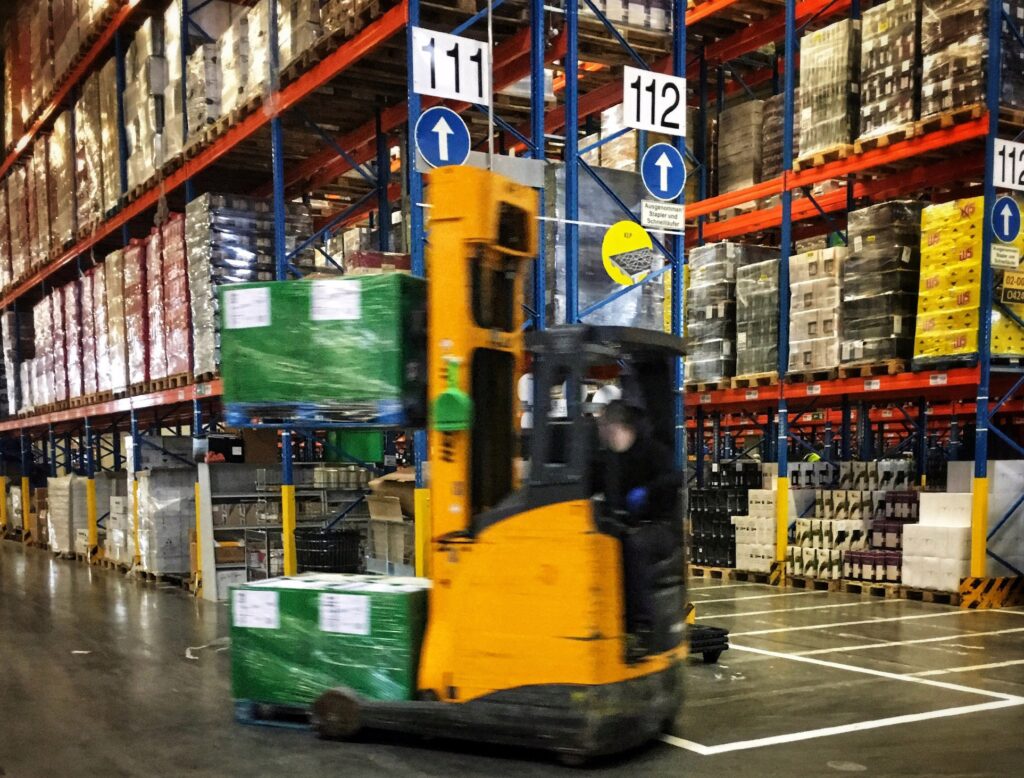
Warehouses and manufacturing facilities depend on clear visual communication in a way that a typical office never has to think about: floor markings that keep forklift traffic organized, safety signage that meets regulatory requirements, and wayfinding that helps new employees and visitors navigate a large facility without getting in the way of active work.
A wide format printer is well suited to producing this kind of signage in-house, which matters in facilities where signage needs change as layouts, equipment, and safety requirements evolve.
Types of Signage Common in These Environments
- Floor marking tape and graphics for traffic lanes, staging areas, and safety zones
- OSHA-relevant safety signage for hazard areas, PPE requirements, and emergency exits
- Wayfinding signage for large facilities with multiple departments or zones
- Equipment and workstation labeling
- Banners and signage for facility events, training days, or visitor areas
Why Durability Is the Top Priority Here
Unlike retail or office signage, warehouse and manufacturing signage has to survive forklift traffic, spills, temperature swings, and constant foot traffic. A material choice that works fine for an office lobby graphic will often fail quickly on a warehouse floor. This makes substrate selection, not just print quality, the most important decision in this kind of project.
Choosing the Right Material for the Environment
Floor graphics need slip-resistant, abrasion-resistant laminates rated for the kind of traffic they’ll see, while wall-mounted safety signage can often use more standard rigid or semi-rigid substrates.
Our guide on media types for large format printing is a useful starting point, though industrial floor applications often call for specialized laminates beyond the standard options covered there, worth discussing directly with your print provider.
Updating Signage as Operations Change
Warehouse layouts change more often than most people outside operations realize, new equipment, reorganized storage zones, updated safety protocols, all of which can require new or updated signage. Facilities relying on an outside sign vendor for every change often let outdated signage linger longer than they should simply because reordering feels like a hassle. In-house printing removes that friction, making it easier to keep signage current as the facility evolves.
Compliance and Consistency Across Multiple Facilities
For companies operating more than one warehouse or manufacturing site, producing safety and wayfinding signage from a central wide format printer helps ensure every location uses consistent formatting, colors, and terminology, which matters both for employee safety training consistency and for meeting the same compliance standard across every site rather than whatever a local vendor happened to produce for each individual location.
Beyond Signage: Supporting Document-Heavy Operations
Facilities that already use wide format printing for large drawings, schematics, or floor plans often find it useful to combine this with a broader document management approach for organizing facility drawings and records.
Our piece on how construction companies use wide format and document management together covers a similar dynamic that applies to manufacturing and warehouse operations working with detailed facility plans.
Getting Started
Facilities considering in-house wide format printing usually start by cataloging their most frequently reordered or updated signage, since that’s the clearest source of savings and speed improvement. High-durability floor graphics with infrequent updates may still make sense to source from a specialized outside vendor, while wayfinding and general facility signage that changes more often are strong early candidates for in-house production.
Involving Safety and Operations Teams in the Decision
Signage decisions in industrial environments shouldn’t sit only with whoever manages office equipment purchasing. Safety officers and operations leads typically know exactly which signage causes recurring confusion or gets damaged fastest, and looping them into the equipment decision from the start tends to produce a better outcome than treating this as a standard print purchase. It also helps build buy-in for keeping signage current once the equipment is in place, since the teams who rely on clear signage daily are the ones most invested in it staying accurate.
Some facilities designate a specific point person, often in safety or facilities management, to own signage requests and updates going forward, which keeps the system from reverting to ad hoc, inconsistent signage requests scattered across different departments.
Documenting Signage as Part of Safety Audits
Facilities that undergo regular safety audits or inspections benefit from keeping a simple log of when major signage was installed or updated and why, tied to specific layout changes or safety protocol updates. This kind of documentation can be genuinely useful during an audit, showing a clear history of proactive signage maintenance rather than leaving an inspector to guess whether outdated signage reflects negligence or a recent, undocumented update.
In-house printing capability makes this kind of recordkeeping easier to maintain consistently, since updates happen on a predictable internal schedule rather than being tracked loosely across multiple outside vendor invoices and purchase orders over the years.
Frequently Asked Questions
Can a standard wide format printer produce floor graphics durable enough for forklift traffic?
With the right laminate or overlaminate film rated for heavy foot and vehicle traffic, yes. The printer itself is usually less of a limiting factor than choosing an appropriately rated protective laminate.
Does OSHA have specific requirements for safety signage colors and formats?
Yes, OSHA and ANSI standards specify colors and symbols for various types of safety signage. It’s worth confirming your designs meet current requirements before printing, regardless of whether the signage is produced in-house or outsourced.
How often should warehouse safety signage be reviewed and updated?
This varies by facility, but signage should be reviewed whenever layouts, equipment, or safety protocols change, and periodically even without a specific trigger, to check for fading, damage, or outdated information.
Is in-house signage production cost-effective for a single warehouse?
It depends on signage volume and frequency of change. A facility that regularly updates or replaces signage tends to see faster payback than one that rarely changes its layout.
Can wide format printers handle rigid substrates like foam board for wall-mounted signs?
Many wide format printers support rigid or semi-rigid substrates directly, though very thick rigid board sometimes requires a flatbed printer rather than a standard roll-fed wide format device.
What’s the biggest mistake facilities make with in-house safety signage?
Choosing a substrate and laminate suited for indoor office use rather than an industrial environment, which leads to signage that fades, peels, or wears out much faster than expected.
Keep Facility Signage Current and Durable
If your warehouse or manufacturing facility is relying on outdated signage because reordering from an outside vendor is a hassle, in-house wide format printing solves that directly.
Explore our wide format printers or contact us to talk through your facility’s signage needs.