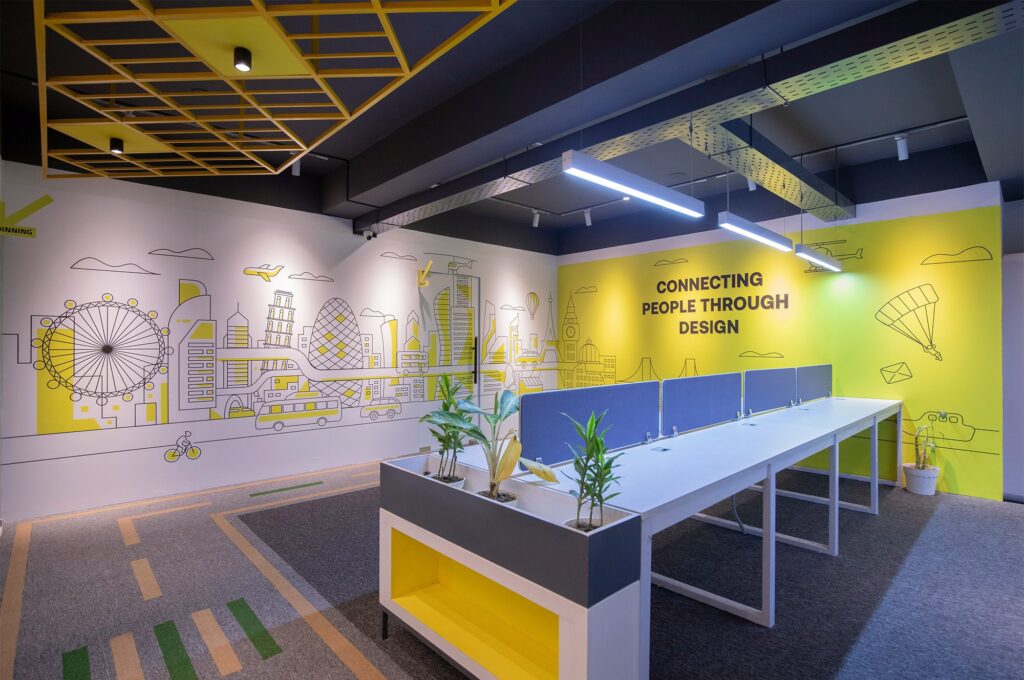
Custom wall graphics, branded murals, and printed wallcoverings have become a common feature in offices, retail spaces, restaurants, and hospitality environments looking to create a distinct visual identity without a full custom paint job. Producing this kind of work has traditionally meant hiring an outside specialty print vendor for every project.
Wide format printers (or large format printers) capable of producing high-quality wall graphics and interior murals bring more of this work in-house, which is worth understanding whether you’re an interior design firm, a facilities team, or a business simply looking to refresh its own space regularly.
What Interior Wall Graphics Typically Involve
- Branded office wall murals and lobby graphics
- Custom wallcoverings for retail and hospitality interiors
- Conference room and collaborative space graphics
- Wayfinding-integrated wall art for larger facilities
- Temporary or seasonal wall treatments for retail and event spaces
Why Color Accuracy Matters More Here Than in Most Applications
Unlike a promotional banner that’s judged mostly on legibility, a wall graphic or mural is often a centerpiece of a room’s design, meaning color accuracy and consistency matter enormously, especially when a design includes large, flat color fields where any banding or inconsistency is highly visible.
Our piece on common color calibration problems in wide format printing covers the issues that show up most in this kind of large-format, color-critical work.
Choosing Ink and Substrate for Interior Applications
Interior wall graphics are typically viewed up close and for extended periods, which puts a premium on both image sharpness and a substrate that looks intentional rather than like a printed sign.
Our guide on dye vs. pigment ink for wide format printing explains how ink choice affects color vibrancy and longevity, both of which matter for a mural meant to last for years in a well-trafficked space.
Material Options for Wall Applications
Wall graphics use different substrates than signage or banners, ranging from adhesive-backed wallpaper-style media to canvas mounted for a more textured, artistic look.
Our overview of media types for large format printing is a useful starting point for understanding which substrate fits a given interior application.
Installation Considerations
Printing the graphic is only part of the project. Wall surfaces need proper preparation, and larger murals are often printed in panels that need to be aligned carefully during installation.
Businesses new to this kind of project sometimes underestimate how much the installation itself affects the final result, regardless of how well the graphic was printed.
Who Typically Benefits From In-House Capability
Interior design firms producing custom graphics regularly for clients, facilities teams at larger companies that refresh branded spaces on a rolling basis, and hospitality or retail businesses that frequently update their interior look all tend to see the clearest return from bringing this work in-house rather than sourcing it project by project from outside vendors.
When Outsourcing Still Makes Sense
For a one-time mural or a highly specialized finish, like textured or dimensional wallcoverings, an outside specialty print vendor with dedicated experience in that specific finish may still be the better choice.
In-house wide format printing tends to make the most sense for businesses producing this kind of work repeatedly, rather than as an occasional one-off project.
Working With a Client’s Existing Design
For interior design firms specifically, a common workflow is receiving a finished design concept from a client or their own design team and needing to translate it into a print-ready file at true wall dimensions.
This step is easy to underestimate, since a design that looks correct at a small scale on screen can reveal issues, low-resolution source images, color that doesn’t translate the way expected, once blown up to cover an entire wall.
Building in time for a proof print of a smaller section before committing to a full mural print run helps catch these issues early.
It also helps to establish a clear file specification checklist for clients or designers submitting artwork, covering resolution, color mode, and bleed requirements, so that back-and-forth revisions don’t eat into an already tight installation timeline.
Building a Portfolio of Completed Work
Interior design firms bringing wide format printing in-house often find it worthwhile to photograph completed installations systematically, both as a design portfolio for future client pitches and as a practical record of which substrate and finish combinations worked well for a given space and lighting condition.
Over time, this internal library becomes a useful reference for recommending materials to new clients based on what has actually held up well in similar past projects, rather than relying on manufacturer specifications alone.
This kind of documentation also helps train new team members faster, since they can see real completed examples alongside the reasoning for why a particular material or finish was chosen, rather than starting from scratch on every new project.
Some firms also use this portfolio during client sales conversations, showing prospective clients physical or photographed examples of past mural and wall graphic work rather than relying purely on digital renderings that don’t always translate accurately to how a finished piece will actually look and feel in a real space.
Frequently Asked Questions
Can a standard wide format printer produce a wall mural?
Many wide format printers designed for signage and graphics can also produce mural-quality output, though panel width, ink type, and resolution all affect how well a specific device handles this kind of work.
How long do printed wall graphics typically last?
This depends on the ink, substrate, and lighting conditions, but well-produced interior wall graphics on appropriate material can last several years in a normal indoor environment.
Do large murals need to be printed in multiple panels?
Often yes, depending on the printer’s maximum width and the size of the wall. Panel seams are typically planned into the design so they’re minimally visible once installed.
Is pigment or dye ink better for wall graphics?
Pigment inks generally offer better fade resistance for graphics that will be displayed long-term, while dye inks can offer more vibrant color for shorter-term or accent applications.
Can interior wall graphics be removed without damaging the wall?
Removable, adhesive-backed wallcovering materials are designed for this, though the right choice depends on the wall surface and how long the graphic will be up before removal.
Do we need a professional installer for large wall graphics?
For larger or multi-panel installations, professional installation helps ensure proper alignment and a bubble-free finish, though smaller single-panel graphics are often manageable in-house with some care.
Bring Custom Wall Graphics In-House
If your business or clients regularly need custom interior graphics, an in-house wide format printer can shorten the timeline and improve consistency.
Explore our wide format printers or contact us to talk through your interior graphics needs.